Wednesday, 19 June 2024
Tuesday, 29 August 2023
GSLV-F12/NVS-01 Mission


GSLV-F12/NVS-01 mission is accomplished successfully on Monday, May 29, 2023. This Geosynchronous Satellite Launch Vehicle (GSLV) mission deployed NVS-01 navigation satellite, weighing about 2232 kg, into a Geosynchronous Transfer Orbit. The vehicle lifted off at 10:42 hours IST from the second launch pad at SDSC-SHAR, Sriharikota and injected the satellite after about 19 minutes of flight.
NVS-01 is the first of the second-generation satellites envisaged for the Navigation with Indian Constellation (NavIC) services. NVS series of satellites will sustain and augment the NavIC with enhanced features. This series incorporates L1 band signals additionally to widen the services. For the first time, an indigenous atomic clock will be flown in NVS-01.
India’s First Mission to Study the Sun, Aditya-L1, will be Launched by June-July: ISRO chairman

Indian Institute of Astrophysics (IIA) handed over to ISRO, the Visible Line Emission Coronagraph (VELC), the primary payload on board Aditya-L1, which is India’s first dedicated scientific mission to study the Sun, to be launched by June or July. The handing over ceremony was held in the presence of the ISRO Chairman S Somanath at the Centre for Research and Education in Science and Technology (CREST) campus of IIA. IIA said it has successfully finished assembling, testing and calibrating the VELC, which is the largest and one of the most technically challenging of the seven payloads/telescopes that will fly on Aditya-L1, at its CREST campus.
About The Payloads In Aditya-L1:
In total Aditya-L1 has seven payloads, of which the primary payload – the VELC, is designed and fabricated by the Indian Institute of Astrophysics (IIA, Bengaluru). The other six payloads are being developed by the ISRO and other scientific institutions. Understanding the effect of the Sun on the Earth and its surroundings has become very important now and Aditya-L1 aims to shed light on this topic. The payload will be taken to the R. Rao Satellite Centre (Bengaluru), where it will be integrated with the Aditya-L1 satellite and will undergo further testing, evaluation and finally launched using the PSLV.
About The Visible Line Emission Coronagraph (VELC) Payload:
- The VELC payload will observe the corona continuously and the data provided by it is expected to answer many outstanding problems in the field of solar astronomy.
- No other solar coronagraph in space has the ability to image the solar corona as close to the solar disk as VELC can (can image it as close as 1.05 times the solar radius).
- It can also do imaging, spectroscopy, and polarimetry at the same time, and can take observations at a very high resolution.
What is the Aditya-L1 Mission:
- Aditya (in Sanskrit means Sun) is a planned coronagraphy spacecraft to study solar atmosphere (solar corona – outermost part).
- It is currently being designed and developed by ISRO and various other Indian research institutes.
- First dedicated Indian mission to observe the Sun, it is planned to be launched in June-July 2023 aboard a PSLV-XL launch vehicle. It was conceptualised in 2008 and was initially envisaged as a small 400 kg satellite.
- The mission’s objectives have subsequently been broadened and it is now intended to be a comprehensive observatory of the sun and space environment.
- It will be placed in an orbit around the Lagrange (L1) point (L1 is about 1.5 million kms from Earth) between Earth and the sun (so renamed – “Aditya-L1“).
What are Lagrange Points:
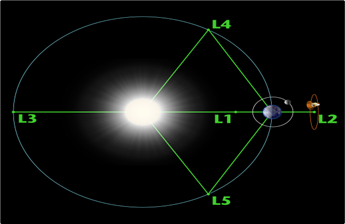
- Lagrange points are positions in space where objects sent tend to stay there, as the gravitational pull of two large masses precisely equals the centripetal force required for a small object to move with them.
- These points in space can be used by spacecraft to reduce fuel consumption needed to remain in position.
- The first Lagrangian point of the Sun-Earth system, L1 orbit, allows Aditya-L1 to look at the sun continuously.
𝐀𝐃𝐈𝐓𝐘𝐀-𝐋𝟏

Aditya L1 shall be the first space based Indian mission to study the Sun. The spacecraft shall be placed in a halo orbit around the Lagrange point 1 (L1) of the Sun-Earth system, which is about 1.5 million km from the Earth. A satellite placed in the halo orbit around the L1 point has the major advantage of continuously viewing the Sun without any occultation/eclipses. This will provide a greater advantage of observing the solar activities and its effect on space weather in real time. The spacecraft carries seven payloads to observe the photosphere, chromosphere and the outermost layers of the Sun (the corona) using electromagnetic and particle and magnetic field detectors. Using the special vantage point L1, four payloads directly view the Sun and the remaining three payloads carry out in-situ studies of particles and fields at the Lagrange point L1, thus providing important scientific studies of the propagatory effect of solar dynamics in the interplanetary medium
The suits of Aditya L1 payloads are expected to provide most crucial informations to understand the problem of coronal heating, coronal mass ejection, pre-flare and flare activities and their characteristics, dynamics of space weather, propagation of particle and fields etc.
Science Objectives:
The major science objectives of Aditya-L1 mission are:
- Study of Solar upper atmospheric (chromosphere and corona) dynamics.
- Study of chromospheric and coronal heating, physics of the partially ionized plasma, initiation of the coronal mass ejections, and flares
- Observe the in-situ particle and plasma environment providing data for the study of particle dynamics from the Sun.
- Physics of solar corona and its heating mechanism.
- Diagnostics of the coronal and coronal loops plasma: Temperature, velocity and density.
- Development, dynamics and origin of CMEs.
- Identify the sequence of processes that occur at multiple layers (chromosphere, base and extended corona) which eventually leads to solar eruptive events.
- Magnetic field topology and magnetic field measurements in the solar corona .
- Drivers for space weather (origin, composition and dynamics of solar wind .
Aditya-L1 Payloads:
The instruments of Aditya-L1 are tuned to observe the solar atmosphere mainly the chromosphere and corona. In-situ instruments will observe the local environment at L1. There are total seven payloads on-board with four of them carrying out remote sensing of the Sun and three of them carrying in-situ observation.
Payloads along with their major capability of scientific investigation.
| Type | Sl. No. | Payload | Capability |
|---|---|---|---|
| Remote Sensing Payloads | 1 | Visible Emission Line Coronagraph(VELC) | Corona/Imaging & Spectroscopy |
| 2 | Solar Ultraviolet Imaging Telescope (SUIT) | Photosphere and Chromosphere Imaging- Narrow & Broadband | |
| 3 | Solar Low Energy X-ray Spectrometer (SoLEXS) | Soft X-ray spectrometer: Sun-as-a-star observation | |
| 4 | High Energy L1 Orbiting X-ray Spectrometer(HEL1OS) | Hard X-ray spectrometer: Sun-as-a-star observation | |
| In-situ Payloads | |||
| 5 | Aditya Solar wind Particle Experiment(ASPEX) | Solar wind/Particle Analyzer Protons & Heavier Ions with directions | |
| 6 | Plasma Analyser Package For Aditya (PAPA) | Solar wind/Particle Analyzer Electrons & Heavier Ions with directions | |
| 7 | Advanced Tri-axial High Resolution Digital Magnetometers | In-situ magnetic field (Bx, By and Bz). |
Back Chandrayaan-3's Vikram lander records 70 degrees Celsius on moon surface, ISRO says 'higher than expected'
𝐏𝐡𝐚𝐫𝐦𝐚𝐜𝐨𝐯𝐢𝐠𝐢𝐥𝐚𝐧𝐜𝐞

Pharmacovigilance, a critical component of public health and drug regulation, is the systematic monitoring, assessment, and management of the safety profile of pharmaceutical products. Its primary goal is to identify and minimize potential risks associated with these products, ensuring their safe and effective use.
Once a drug is approved and enters the market, pharmacovigilance processes come into play. Adverse events, which encompass any unexpected or harmful effects caused by a medication, are reported by healthcare professionals, patients, and sometimes even pharmaceutical companies. These reports form the basis of pharmacovigilance efforts.
The data collected is meticulously analyzed to identify patterns, trends, and potential causal relationships between drugs and adverse events. This process helps detect previously unrecognized side effects, interactions, or even rare conditions that may not have been evident in clinical trials. Timely detection of such issues allows regulatory authorities to take appropriate actions, which might include issuing warnings, updating labeling information, or even withdrawing a drug from the market if the risks outweigh the benefits.
Pharmacovigilance also plays a pivotal role in post-market surveillance, where the safety of drugs is continuously monitored as they are used by a broader population. This ongoing assessment helps refine our understanding of a drug's safety profile and ensures that any emerging safety concerns are promptly addressed.
Collaboration among various stakeholders is key to the success of pharmacovigilance. Regulatory agencies, healthcare providers, pharmaceutical companies, and patients all contribute to the process by reporting adverse events and sharing information. This collective effort strengthens the overall safety surveillance network.
In recent years, advancements in technology and data analysis have transformed pharmacovigilance. Automated systems, data mining techniques, and artificial intelligence tools are used to process large volumes of data efficiently, identify trends, and provide early warnings for potential safety issues.
In conclusion, pharmacovigilance is a vital component of modern healthcare and drug regulation. By monitoring and managing the safety of pharmaceutical products throughout their lifecycle, it enhances patient safety, improves regulatory decision-making, and fosters a culture of responsible medication use.
𝓜𝓮𝓭𝓲𝓬𝓪𝓵 𝓒𝓸𝓪𝓭𝓲𝓷𝓰

Medical coding is the process of assigning standardized codes to medical diagnoses, procedures, and services. These codes are used for various purposes, including medical billing, insurance reimbursement, data analysis, and research.
Medical coding is necessary because it ensures accurate and consistent documentation of medical records, allows for efficient communication between healthcare providers, insurance companies, and regulatory agencies, and facilitates the accurate and timely processing of medical claims.
There are different coding systems used in medical coding, including:
International Classification of Diseases (ICD): ICD codes are used to classify and code diagnoses, symptoms, and medical conditions. The current version is ICD-10, with ICD-11 set to be implemented in the future.
Current Procedural Terminology (CPT): CPT codes are used to document and code medical procedures, surgeries, and specialized services. This system is developed and maintained by the American Medical Association (AMA).
Healthcare Common Procedure Coding System (HCPCS): HCPCS codes are used for coding various healthcare services, equipment, supplies, and medications. This system includes both Level I codes (CPT codes) and Level II codes (additional codes developed by the Centers for Medicare and Medicaid Services).
Medical coders are responsible for assigning appropriate codes based on the documentation provided by healthcare providers. They must have knowledge of anatomy, medical terminology, disease processes, and coding guidelines. Accuracy and attention to detail are critical in medical coding to ensure proper reimbursement and compliance with coding regulations.
Monday, 12 June 2017
NEET 2017 Results Likely to be Declared by CBSE Today on www.cbseneet.nic.in

New Delhi: The National Eligibility-cum-Entrance Test (NEET) results 2017 is likely to be declared by the Central Board of Secondary Education (CBSE) on www.cbseneet.nic.in on Monday, June 12, sources told CNN-News18.
In a relief to lakh of candidates who appeared for the exam this year, the Supreme Court on Monday gave the go-ahead to the CBSE to declare the result which had been put on hold by the Madras High Court.
The result, when declared, would be available on cbseneet.nic.in. Here’s how you can check your score:
— Log on to cbseneet.nic.in, CBSE’s official website for NEET
— Click on 'NEET results 2017'
— Enter the roll number and other required details
— Click on 'Submit'
— Download the NEET Result 2017 and take a print out for future reference
Around 10.5 lakh students appeared for the exam in either Hindi or English while around 1.25 lakh to 1.50 lakh students appeared in eight vernacular languages —Tamil, Telugu, Marathi, Bengali, Assamese, Gujarati, Oriya and Kannada.
The NEET 2017 result had been held up due to an order of the Madras High Court which on May 24 granted interim stay on the publication of NEET results on a batch of pleas alleging that a uniform question paper was not given in the examination and there was a vast difference between the ones in English and in Tamil.
The NEET examination for admission to undergraduate medical and dental courses was held on May 7.
Sunday, 19 February 2017
Top 100 Biology General Knowledge Questions and Answers
 |
| Quick knowledge |

1. Trunk of tree increases in grith due to cell division in which tissue? – Meristematic tissue
2. Which tissue in cells have lost the capicity of cell division? – Permanent tissue
3. Which scientist studied about wheat rust problem? – K. C. Mehta
4. Most of the plants obtain nitrogen from the soil in which from? – Nitrates
5. Which fungus is responsible for disease late blight of potato? – Phytophthora infestans
6. Which is responsible for red rot of sugarcane? – Collectorichum falcatum
7. Which stage of development of insect is most harmful for crop? – Caterpillar
8. In India famous Bengal famine accurred in 1942 by which disease? – Leaf spot of rice
9. Which factors are most responsible for disease in plant? – Fungi
10. Which fungus is responsible for the tikka disease of groundnut? – Cercosplora personata
11. Which animals who have constant body temperature? – Homeothermic
12. What is treatment of body defects through massage and exercise? – Physiotherapy
13. What is making interesting discoveries unexpectedly or by accident? – Serendipity
14. What is Study of growth and development of embryo? – Embryology
15. Which branch of biology is concerned with study and function of internal organ of organism? – Physiology
16. Which branch of science deal with the study of causative agent of disease? – Etiology
17. What is the Study of pulse and arterial blood pressure called? – Sphygmology 2. Which tissue in cells have lost the capicity of cell division? – Permanent tissue
3. Which scientist studied about wheat rust problem? – K. C. Mehta
4. Most of the plants obtain nitrogen from the soil in which from? – Nitrates
5. Which fungus is responsible for disease late blight of potato? – Phytophthora infestans
6. Which is responsible for red rot of sugarcane? – Collectorichum falcatum
7. Which stage of development of insect is most harmful for crop? – Caterpillar
8. In India famous Bengal famine accurred in 1942 by which disease? – Leaf spot of rice
9. Which factors are most responsible for disease in plant? – Fungi
10. Which fungus is responsible for the tikka disease of groundnut? – Cercosplora personata
11. Which animals who have constant body temperature? – Homeothermic
12. What is treatment of body defects through massage and exercise? – Physiotherapy
13. What is making interesting discoveries unexpectedly or by accident? – Serendipity
14. What is Study of growth and development of embryo? – Embryology
15. Which branch of biology is concerned with study and function of internal organ of organism? – Physiology
16. Which branch of science deal with the study of causative agent of disease? – Etiology
18. Which branch of biology deals with the study of processing and preservation of food? – Food technology
19. What is the Study of the effects of toxic chemical substance on animal and plant? – Toxicology
20. What is the Branch of science which deals with the study of skin of man? – Dermatology
21. The release of which fish into wells helps in controlling the mosquitoes? – Gambusia fish
22. Which animal lays eggs and does not produce young ones directly? – Echidna
23. How many pair of heart is found in an earthworm? – Four
24. Which substance found in blood which helps in cloting? – Fibrinogen
25. Which worm reach into intestine of human by eating leaf? – Tape worm
26. Which is the phylum that includes exclusively marine animal? – Echinodermata
27. Which organs has its own wave of autonomic excitation? – Heart
28. What is the short upper part of human intestine next to the stomach? – Duodenum
29. A person feel fatigued due to depositon of which acid in their muscles? – Latic Acid
30. In the retina of eye cells what is present for colour differentiation? – Cones
31. Which gland is responsible for the secretion of insulin? – Pancrease
32. What is considered as the easily digestable source of protein? – Soyabean
33. What percentage of water found in blood plasma of human? – 91 to 92%
34. Which blood vessel bringing blood into Bowman’s capsule? – Afferent arteriole
35. Bu which antibodies are produced in the plasma of blood? – Lymphocytes
36. Which enzyme take part in digestion of milk protein? – Rennin
37. Which part of brain is centre of thirst hunger and sleep? – Hypothalmus
38. Blood Coagualtion is prevented by which chemical when it flow through artery and vein? – Heparin
39. Which organelles in the cell, other than nucleus contains DNA? – Mitochondria
40. What is infolding from the inner membrane of mitochondria called? – Cristae
41. In a living cell what is the site of ribosome formation? – Nucleolus
42. What do both respiration and photosynthesis require? – Cytochromes
43. In absence of ribosome in cell which function does not takes place? – Protein synthesis
44. Deficiency of which vitamin, causes xerophthelmia? – Vitamin A
45. Which antimicrobial drug is suitable for treatment of both tuberculosis and leprosy? – Rifampicin
46. Insects that can transmit diseases to human are referred to as which name? – Vectors
47. Pneumoconiosis affects the workers who work mainly in which industry? – Coal mining industry
48. Lathyrism is caused by excessive consumption of which thing? – Khesari Dal
49. Which part of blood carry out the function of body defence? – White blood cell
50. Which disease is caused due to presence of excess arsenic in water? – Skin Cancer
51. What is the transmission of characters from one generation to next? – Heredity
52. Who got noble prize for artificial synthesis of DNA? – Kornberg
53. What is the smallest part of DNA that undergoes recombination? – Recon
54. By whom was Artificial gene synthesis first done in laboratory? – Khurana
55. By whom the concept of survival of the fittest as advanced? – Herbert Spencer
56. From the evolutionary point of view, which is the most primitive animal? – Turtle
57. Which was the Russian scientist who proposed the theory of origin of life? – Oparin
58. Who published the book ‘Origin of species by natural selection in 1859’? – Darwin
59. Which is most primitive ancestor of man ? – Australopithecus
60. Which harmful element tobacoo exists in tobacoo ? – Nicotine
61. What is abiotic component of ecosystem? – Water
62. What is Study of inter relationship between living organism and their environment? – Ecology
63. Epiphytes are plant which depend on other plants for which purpose? – Mechanical support
64. What amount of energy transfered from one trophic level to next? – 10%
65. Plant and animal living in a particular area, what is it called? – Community
66. Reduced leaves and sunken stomata are the main feature of which thing? – Xerophytes
67. What ratio of forest area needed for ecologycal balance in India? – 33.3%
68. Ultimate environmental hazard to mankind, why? – Due to Nuclear pollution
69. Sound become hazardous noise pollution at which level? – Above 80 dB
70. Which energy do not have the problem of pollution? – Sun
71. Which air pollutant affect the nervous system of man? – Lead
72. By which is the Atmosphere of big metropolition cities is polluted most? – Automobile exhausts
73. National Environmental Engineering research institute is situated in which city? – Nagpur
74. Edward Jenner is related with which disease? – Small pox
75. Which Scientist first explained about circulatory system? – William Harvey
76. Who discovered Anopheles mosquito transmit malaria? – Ronal ross
77. Who discovered the causal organism of the disease Anthrax? – Robert Koch
78. Which Scientists has established the ‘Phylum Annelida’? – Lamark
79. Which Biologist proposed the theory of Germ plasm? – Weisman
80. For which is the southern blot technique used for the detection? – DNA
81. For which is the northern blot technique used for the detection? – RNA
82. What is the introduction of foreign genes for improving genotype? – Immunisation
83. Which vitamin is transformed in golden rice ? – Vitamin A
84. Human protein x –1 – antitrysin is used for which disease? – Emphysama
85. Which type of cell has the ability to develop into any type of all ? – Stem cell
86. What is the percentage of land area covered under forest according to Indian Forest policy? – 33%
87. Which organisation is responsible for maintaing Red data book? – IUGN
88. What is the main cause of extinction of species from tropics? – Deforestation
89. What is the number of plant species estimated to be present in India? – 40,000
90. Which group has the highest number of endangered species ? – Reptiles
91. Silent valley having rare plant and animal is located in which state? – Kerala
92. Which is the first national park established in India? – Corbet 93. Insectivorous plant generally grow in soil which is deficient in which gas? – Nitrogen
94. What is one-way relationship where one species benefits at the expense of another is called? – Parasitism
95. What is symbiotic relationship in which both species benefit’ is best described? – Mutualism
96. Which of a species describes the tropic function it fills in its environment? – Niche
97. What is the least influential in determining the distribution of terrestrial biomes? – Salinity
98. What is the term for the maximum number of individuals that an area can support indefinitely? – Carrying capacity
99. The massive hole in the ozone layer over the Antarctica was first discovered in which year? – 1985
100. Which animals have a diet mainly consisting of bamboo? – Red pandas
 |
| Quick knowledge |
Saturday, 3 December 2016
आज का इतिहास 03 दिसंबर (देश-विदेश)

आज ही के दिन यानि 03 दिसंबर को भारत सहित विश्व इतिहास की प्रमुख घटनाएं इस प्रकार है–
1469 – इटली के विख्यात राजनेता और इतिहासकार निकोलो मैक्यावेले का फ़लोरेन्स नगर में जन्म हुआ।
1790 – लार्ड कार्नवालिस ने आपराधिक मामलों में न्याय की ताकत मुशिर्दाबाद के नवाब से छीन कर अपने हाथ में कर ली और सदर निजामत अदालत को कोलकाता स्थानंतरित कर दिया गया।
1828 – एंड्रयू जैक्सन अमेरिका के सातवें राष्ट्रपति चुने गए।
1829 – वायसराय लॉर्ड विलियम बैंटिक ने भारत में सती प्रथा पर रोक लगायी।
1882 – प्रसिद्ध कलाकार नंदलाल बोस का जन्म हुआ।
1884 – भारत के पहले राष्ट्रपति राजेंद्र प्रसाद का जन्म बिहार के जीरादेई में हुआ।
1889 – स्वतंत्रता आंदोलन में सबसे कम उम्र में फांसी पर चढ़ने वाले क्रांतिकारी खुदीराम बोस का जन्म हुआ।
1910 – फ्रांसीसी भौतिकशास्त्री जॉर्जेज क्लाउड द्वारा विकसित विश्व के पहले नियोन लैम्प का पहली बार पेरिस के मोटर शो में प्रदर्शन किया।
1912 – तुर्की, बुल्गारिया, सबिर्या, यूनान और मोंटेगरो ने युद्धविराम समझौता किया।
1937 – भारतीय भाषाविद विनोद बिहारी वर्मा का जन्म हुआ।
1948 – पूर्वी चीन सागर में चीनी शरणार्थी जहाज को ले जा रहे जहाज कियांग्या में विस्फोट होने से 1,100 लोगों की मौत हुई।
1967 – इंडोनेशिया के पूर्व राष्ट्रपति सुकर्णो नजरबंद किये गए।
1970 – लार्ड कार्नवालिस ने आपराधिक मामलों में न्याय की ताकत मुर्शिदाबाद के नवाब से छीनकर अपने हाथ में कर ली और सदर निजामत अदालत को कोलकाता स्थानांतरित कर दिया।
1971 – भारत और पाकिस्तान के बीच युद्ध शुरू होने के बाद देश में आपातकाल लागू हुआ।
1976 – दक्षिण अफ्रीका के पूर्व विकेट कीपर मार्क बाउचर का जन्म हुआ। उन्होंने 147 टेस्ट मैच में 5515 रन बनाए। विकेट के पीछे 525 कैच लपके तथा 23 स्टंप्स किए। 1979 – हॉकी के जादूगर ध्यान चंद का निधन हुआ। 1984 – भोपाल स्थित यूनियन कार्बाइड फैक्ट्री से विषैली गैस लीक होने से कम से कम 3000 लोग मारे गए और कई हजार व्यक्ति शारीरिक विकृति के शिकार हो गए। 1989 – रूस के राष्ट्रपति मिखाइल गोर्बाच्योव और अमेरिका के राष्ट्रपति जॉर्ज बुश ने शीत युद्ध खत्म होने की घोषणा की। 2004 – भारत और पाकिस्तान 40 वर्षो के बाद मुनाबाव और खोखरापार के बीच रेल संपर्क फिर से बहाल करने के लिए सहमत हुए। 2011 – फिल्म अभिनेता देव आनंद का निधन हुआ।
 Rupee Exchange Rate


